OmenSource
Playtest review

Content tested: Three tutorial lessons in The Cabal campaign and one in the Elias Rook campaign. Playtest ended during onboarding.
Playtest video
Developer Questions
Where did the rules or next move first become unclear?
Honestly, I struggled immediately during the second Cabal tutorial because of the lack of context. Certain individual actions made sense, such as gaining credits to fund further actions or using Plot (though I think thats confusingly named) to draw a card, I struggled to understand how everything fitted together. I wasn't clear on the overall turn structure, the reasoning behind many of the actions I was taking, or how those actions contributed towards me winning the game.
I completed three Cabal tutorials and one Elias Rook tutorial, and at no point did I come away understanding how to win in either campaign. I understand you may introduce this later but I think introducing that objective early on, followed by the fundamental rules and then gradually building towards the more complicated mechanics, would make more sense.
What would make me choose to play again?
I will be honest, it would take a lot for me to play this again. As a player, I did not have fun. For me, the biggest improvement would be a significantly more structured onboarding experience. I'd like the tutorial to introduce the basic rules one at a time, explaining not just what actions I can take, but why I might choose to take them.
At times, the instructions felt a little disconnected from one another. I would be asked to play a card at a location, lock a door or search for an artifact, but I didn't always understand how those actions related to each other or why I was doing them. Why, at one point did I take an action to expedite a survey in a tunnel for example?
Ultimately, I'd be happy to revisit the game for a playtest following improvements to the onboarding, but I wouldn’t go through that tutorial again personally. I don't feel I've experienced enough of the underlying gameplay to form a fair opinion of it, and I'd be interested to see how it plays once I can better understand the decisions I'm making.
Unfortunately, my initial experience wasn't particularly positive, but hopefully some of my thoughts here will help elaborate on why, and be useful so other potential players are retained.
Overall Experience
I want to start by being quite clear about the nature of this feedback, because I appreciate that some of what follows is going to sound rather critical. The goal is to give you actionable feedback that you can use to improve your game. I felt like so much vital information was just omitted early on, and unfortunately, I reached a point where I felt unable to continue playing due to the lack of clear explanation and structured onboarding. If you stop reading at this point, I would simply urge you to consider an overhaul of your player onboarding as it made me want to stop playing, even very early on.
I spent approximately 20-30 minutes across both campaigns (some video is missing as I returned to the game and stupidly recorded the wrong browser window), completing three tutorial lessons as The Cabal and one as Elias Rook. After completing four tutorial lessons, I still had not been taught what winning looked like, what I was ultimately trying to achieve, or how the various actions I was taking contributed towards winning the game. I think that is probably the most important finding from this playtest. I still, despite playing the game, and spending the best part of 90 minutes going through my recording, and writing this, have no idea what it is I am meant to be doing, or why.
Despite that, I have a gut feeling that the underlying game mechanics are potentially not actually too complicated. I simply don't know enough about them to make that judgement because the onboarding actually acts as a barrier to play IMO. Throughout the tutorial lessons I played, the game was asking me to perform actions without giving me enough context to understand what I was doing or why I was doing it (I elaborate on this below).
You specified that you don't need a long report, and that you just wanted some notes. I don't consider this too long, so hopefully there is something useful in here. I don't think it would be useful to manufacture feedback about balance, strategy or progression when I couldn't get far enough to understand any of these. Again, my overwhelming feedback here is that this game is extremely unclear, and the onboarding is a struggle to get through. From a player experience perspective, this was not enjoyable at all as I felt like I was fighting the game to try learn more. I think player onboarding needs to be your immediate priority.
Onboarding
My biggest criticism is that the tutorial constantly tells me what actions to take, but doesn't properly teach me how to play, and never gives me a clear understanding of what I am even working toward. I'll use Yu-Gi-Oh as an example. When learning that game, I can be taught that a card can be played face up or face down, or in attack or defence mode. I learn what those different states mean and why I might choose one over another. Similarly, in Slay the Spire, I can understand that playing a particular card will deal damage, provide defence or apply a particular effect. I can associate an action with an outcome and begin making decisions for myself. In Omensource, I was repeatedly instructed to perform actions without understanding anything related to their significance.
Once the board (I refer to it as the board though I appreciate thats not entirely accurate ) loads, I'm introduced to actions such as Income and Plot, which I think are easy to understand. Had everything been introduced like this, it would be ideal. Plot in itself is an odd choice for an action that I think essentially just means draw from your deck (unless I'm mistaken). Elias equivalent actions here are a bit clearer, but I didnt have context of them at the time of playing.
I would expect to be introduced to the concept of turns pretty much immediately. Explain that I have a certain number of actions available, that I can spend them in different ways, and that Elias/The Opponent will then take his turn. Explain what credits are, how they're spent, and what the different types of cards actually do. Explain these basics to me without the shroud of a really confusing story. Explain to me why there are locations on the board. Explain what a location being linked means. Explain to me why the locations have different icons. Explain the core game elements. Explain, explain, explain.
I also think it's important to explain how to win/complete a level. I completed four tutorial lessons across both campaigns and was never taught how to win or what a win even looked like. I could follow an individual instruction because you held my hand through the steps, but I had no understanding of how those actions fitted into a larger objective.
I'd recommend teaching one fundamental concept at a time, explaining both what an action does and why a player might want to perform it, but you can do this in a much cleaner, concise way than is currently being done.
Cards
Most games with a deck take players a while to build up that deck familiarity, so I wouldnt read too much into the fact I found the cards hard to remember at this stage. That comes with time.
One of the things I struggled with most was understanding why particular cards were being played at particular locations. There is such a huge disconnect here for me personally, and it completely prevented me from having fun as I felt I would have no idea what to do, or why, and I was just blindly following instructions.
In the second Cabal lesson, I'm instructed to draw another Patient Liaison card and use it to protect a location. I understand the instruction itself, but I don't understand what protecting a location means. What am I protecting it from? What happens if I don't protect it? Why is Patient Liaison an appropriate card to use? By definition, a patient liaison is someone who acts as a bridge between different parties, usually in a healthcare context. I couldn't make the connection between that concept and playing the card at a library to interfere with Elias. I'm not suggesting you need to change the name, but the tutorial should at least establish a context for the card, which in my opinion it doesn't, and if that happens in the later lessons, it needs to be earlier.
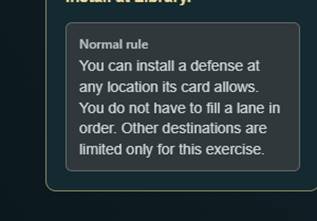
The instruction that I can install a defence at any location its card allows might be useful once I understand the underlying mechanic, but when I reached this step in the tutorial, I was still trying to understand what a defence was and why I needed one, so once again, I was just completely lost as to what I was doing, and why. This onboarding has an ongoing problem where it does not communicate context at all. I feel like the best way I can describe my disconnect with what I was doing, and what I was reading would be like if I was introduced to
Monopoly without ever being made aware there was a board. Imagine in Monopoly as a first time player, who has never seen the board, you roll and are then asked “Do you want to purchase this property?” You’d be so confused, If you were then told “Go to jail”, you’d be more confused. Without the full context, statements are confusing, and I felt I was constantly battling that here.
The Payment Received card refers to an account being paid before a service was requested. Details like that are vague, and I'm not sure why they are even listed on cards. I’d ask, what does that add? Another card (I’ve forgotten the name) refers to a referral being valid while admission is a separate arrangement. Again, I would ask, what is the purpose of including these statements? Are they relevant? Later, I'm told a fingerprint has brought an Unpaid Shift. I couldn't understand how these pieces of terminology connected to the story or actions. As a player, I felt like I was seeing random statements, random instructions, random locations etc. It all felt extremely disjointed, and because of that, my engagement was unfortunately lower than both of us would have liked.
As I said in the opening section, I would strip everything back here, and make the onboarding many many times clearer than it currently is. I would give the player a simpler introduction to both the game and the conflict/story.
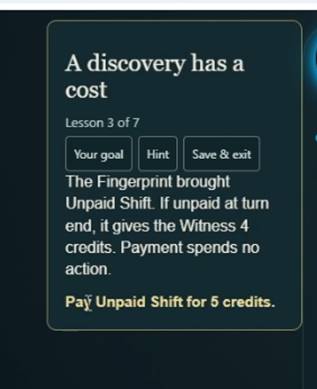
You taught me to drag cards to locations, and then when I had to use Expedite Survey, I had to click the card, then click PLAY CARD, then NOT drag the card on to the Tunnel location, and instead click a second button to play the card at the tunnel. This seems inconsistent with what you had taught me up to that point, as at this stage.
I'd separate introducing a mechanic from explaining its specific rules. Teach me what a defence does first, show an example of it working, and then explain the different ways I can deploy one and why. The same applies to Scout, Expedited Survey and other unfamiliar terms.

Story
I am not able to evaluate the story in any way, as I did not get deep enough to be able to provide you with any concrete feedback on its depth, twists, character arcs etc.
I actually think some of the confusion around the mechanics is compounded by the way the story is introduced. The opening Cabal mission begins with the sentence: 'An ancient debt names God as debtor.' That's hard to process, and I appreciate you may be deliberately trying to create mystery, butI have almost no understanding of the game's premise, and all the proceeding text on that first screen actually made me more confused as opposed to establishing the basis for a story I could get sucked into. I understand that The Cabal and Elias Rook are opposing sides, and that there is some form of ancient debt, ritual and investigation involved but beyond that, I was just a bit lost. I’d add that the landing page on the site doesn’t do much to provide clarity on this either.
The Cabal Campaign
I spent most of my playtime in The Cabal campaign, completing three tutorial lessons. The first introduces credits and card drawing, which seem like sensible starting points, as I said above.
The second lesson introduces protecting locations and installing defences, and is where I began to feel properly lost as the relationship between cards, locations and Elias felt disjointed. I was confused every step of the way.

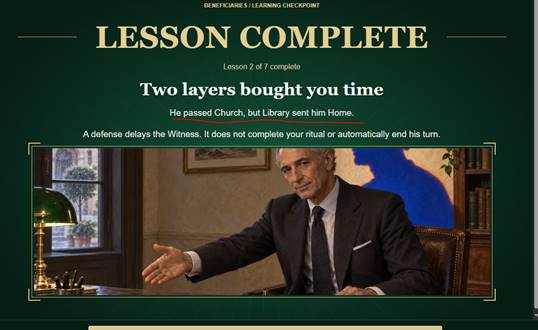
At the end of that lesson, the game tells me Elias passed the Church but the Library sent him home. At the time, I couldn't understand why the Library sent him home or what had happened from a game mechanics/my actions POV. Again, at the time of writing, I still don’t really understand what a defence action is, why its needed, or what it really does.
The third lesson introduces searching for artefacts and the Scout mechanic. One of the instructions in this lesson explicitly explained that Payment Received provides six credits for one action. That's the sort of straightforward mechanical explanation I'd like to see more frequently. However, it also touched on sealed core tokens and artefacts powering a ritual while I was still struggling with the fundamentals, so once again I became lost in what I would call the noise of the story, while I still just didn’t even know what I could do as a player, or why I was taking certain actions as a player.
Elias Rook Campaign
After struggling with The Cabal campaign, I tried playing from Elias Rook's perspective. I completed one tutorial lesson here, but unfortunately had much the same experience, and I’m sorry but I was really not enjoying this so I had to stop playing one tutorial lesson.
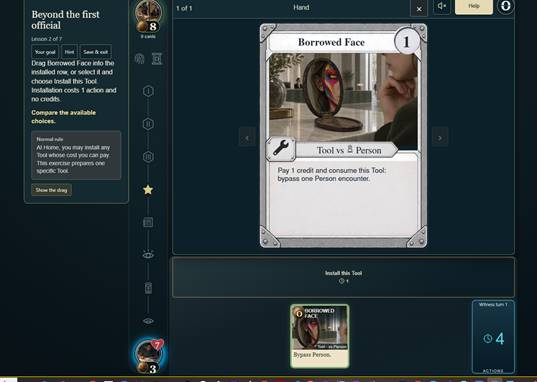
I was instructed to enter a bar and use a Tool card called Borrowed Face, but again, I didn't understand why I was using that card. I think its related to bypassing a Patient Liaison but if it is, this has to be introduced more clearly.. I appreciate it may be getting frustrating to read pages of me saying “X was not clear”, but it wasn’t and I was lost as a player very early on because of that.
UI
The board contains quite a lot of information that isn't immediately explained, which is fine, but its overwhelming, and you could look at greying out a lot of the board unless explicitly needed for the tutorial. The credits beside the character portraits are quite easily understandable, but I wouldn't say the same about the health indicator above Elias or the various indicators between the two profiles. (I have since learned that the vertical UI is essentially an indicator of how close each side is to their objective, but I dont know why this isnt introduced essentially immediately)
The locations contain different icons, and some have question marks, but I wasn't sure what those represented. I also didn't understand the significance of locations being connected. The tutorial says the Church leads to the Library, but I couldn't clearly identify whether that connection was directional or what it meant for gameplay.
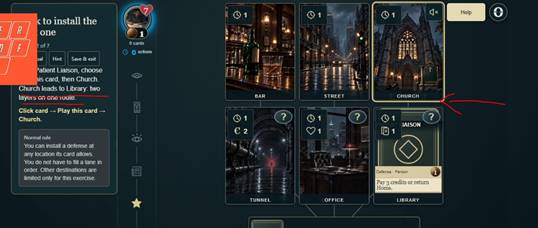
I'd introduce the board's UI elements gradually, explaining them as they become relevant rather than presenting everything at once.
During the second tutorial, I found card dragging a little unreliable. If I started dragging a card, released it to cancel and attempted to drag it again, it could become unresponsive.
On that, unless I am mistaken, there are two ways to play some cards, dragging it onto a location or selecting it and choosing Play Card. Having both is fine, but I think the tutorial could explain the distinction. Is there a reason there are two ways to do the same thing?
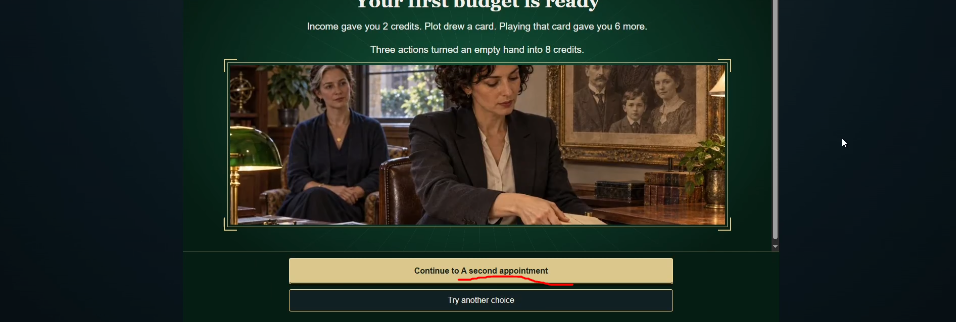
I'd also make lesson names more visually distinct on completion screens, and temporarily grey out irrelevant UI while teaching a specific mechanic. In the screenshot above, for example, I would make A Second Appointment italic, or at least distinguish its mission name.
Visuals
AI generated games are going to be marmite. Personally, this has no bearing on my feedback for playtests. Not everyone has the ability to hire artists, so no comments here will be centered around the AI visuals, and will only be related to the visual presentation.
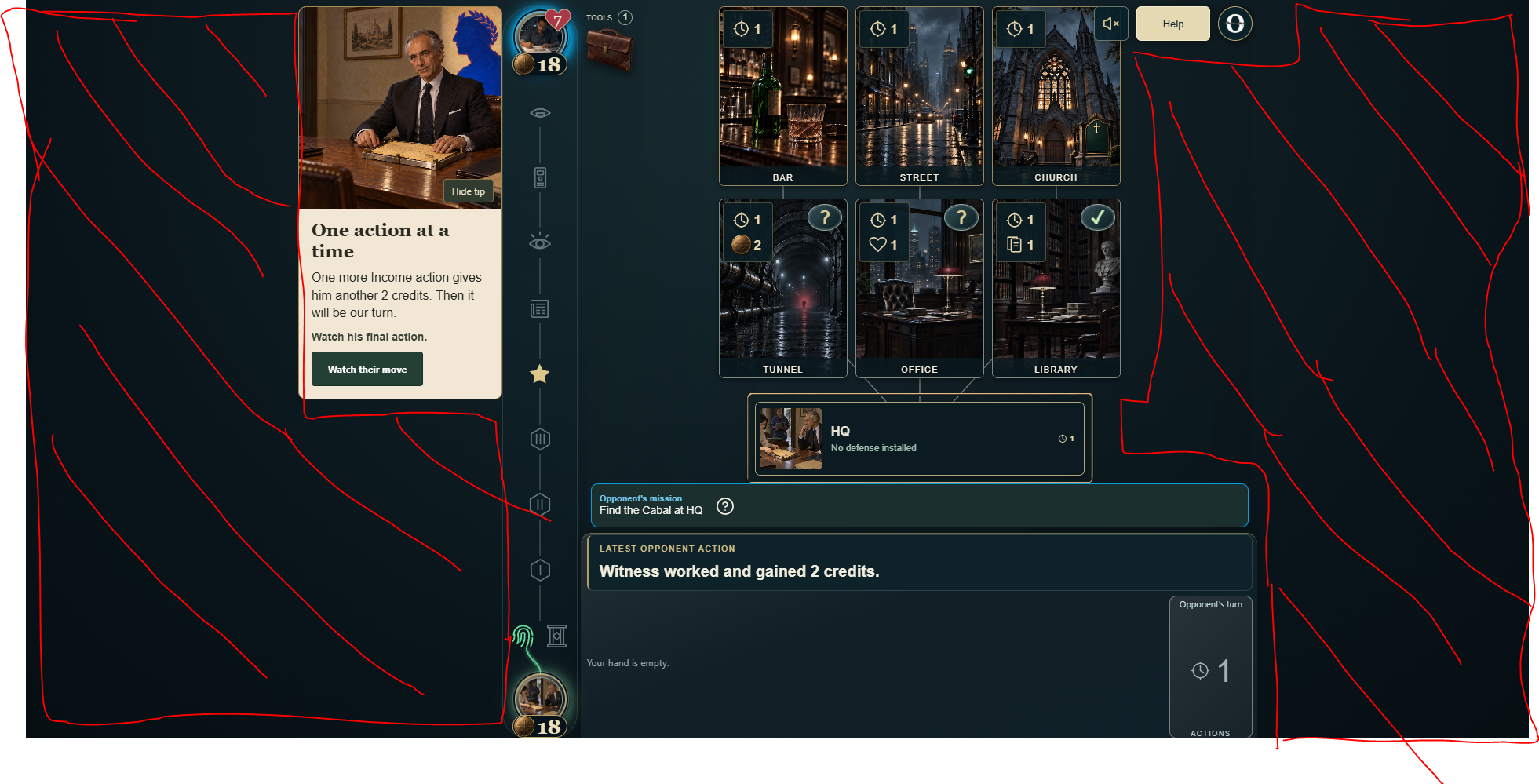
Locations take up the most space, so in turn, it makes it feel like they are most important. The deck is quite prominent, but overall, the biggest consumer of space is actually blank space.
I'd separate general art direction, which is subjective, from visual clarity, which could be improved through better hierarchy, clearer icons and a more focused introduction to the interface. I don't think a complete visual redesign is necessarily required to address onboarding.
Bugs and Smaller Issues
Card Dragging - Cancelling a card drag and attempting to drag it again could leave the interaction unresponsive.
Tutorial Interaction Clarity - It was not always clear how to complete the final instructed action, particularly when placing cards onto locations.
UI Terminology - Several indicators and location connections were not explained clearly. This is primarily a usability issue rather than a technical bug.
Final Thoughts
I think the most useful thing I can tell you from this playtest is that the onboarding needs considerably more attention before I could meaningfully evaluate the game itself.
After four tutorial lessons across both campaigns, I still didn't understand the purpose of the game (how do I win), or how the actions I was taking contributed towards achieving it. I couldn't confidently explain the mechanics or make informed decisions of my own.
My main recommendation would be to simplify the introduction considerably. Explain the objective, establish the turn structure, introduce the core resources and then teach individual mechanics one at a time, making sure the player understands why they're performing each action.
I appreciate this is quite a critical report, but I hope the examples make it clear where my confusion came from and why addressing it is so important. I'd be interested to see how the game feels with a far more structured introduction, because at the moment I haven't been able to experience enough of the underlying game to judge it fairly.